Showing posts with label Lessons from History. Show all posts

Sunday, April 2, 2017

The Twisted Ideology Guiding North Korea’s Leadership

Examining the isolated state’s communist roots
North Korean leader Kim Jong Un watched the ground jet test of a Korean-style high-thrust engine newly developed by the Academy of the National Defence Science in this undated picture provided by KCNA in Pyongyang on March 19, 2017. KCNA/via Reuters
Unlike the Soviet Union—which collapsed and split into over a dozen non-communist nations, or China, whose leaders maintain the rule and ideology of the Communist Party but introduced capitalist markets and allow interaction with the outside world, North Korea has remained an isolated totalitarian state, coming in and out of news headlines as it menacingly brandishes nuclear weapons and ballistic missiles. 
Some have argued that North Korea isn’t exactly communist, as the country removed all references to communism and Karl Marx from its constitution in the 2000s, and because it follows a program of extreme nationalism and implicit dynastic succession. In lieu of Marxism, the official ideology is the so-called “Juche Idea,” a Chinese-derived name that is usually translated as “self-reliance” but may be better understood as a version of dialectical materialism that claims to place people, not productive relations, at the center of historical evolution. 
But in terms of leadership, society, and its strictly controlled command economy, North Korea resembles and surpasses the archetypal authoritarian socialist regimes that existed in the Cold War. Moreover, the state owes its ideological foundations and very existence to communism and communist powers. 
In the 1940s, the Soviet Union sent specialists to help Kim consolidate power and establish a communist regime. They also trained and sent thousands of agents to destabilize U.S.-led efforts to establish a democracy in South Korea. To gain power, Kim used the same formula as nearly every budding communist dictator when he purged “counter-revolutionaries” with the Concentrated Guidance Campaign. Some 800,000 North Koreans fled to the south, and the state labeled family members of individuals who fled to South Korea as “counter-revolutionaries.”
In a style almost exactly mimicking Stalin, Kim Il-Sung erected a cult of personality around himself, purging the Korean Workers’ Party of all dissent and banishing designated class enemies into a network of gulags—the infamous kwanliso. 
In all, the Kim Il Sung regime is believed to have murdered between 710,000 and 3.5 million people, according to researchers, while experts estimate that some 200,000 North Koreans are currently imprisoned in a system of labor camps—of that, 50,000 to 70,000 are Christians. Hundreds of thousands of North Koreans were forced to flee the country, with most going to China.
Kim Il Sung, in particular, targeted Korean Christians. “We have executed all Protestant and Catholic church cadre members and all other vicious religious elements have been sent to concentration camps,” he once proclaimed in 1962. Their beliefs got in the way of the regime’s propaganda campaign effectively proclaiming Kim as effectively a living god. In practice, North Korea’s Juche promotes bizarre forms of ethnic nationalism, describing the Kim family as saviors of the “Korean race.”
Soviet-style plans were initially implemented, including the seizure of private property as well as the seizure of national industries. By 1950, Kim was obsessed with unifying North and South Korea before he received substantial help from Soviet advisors, who helped draw up invasion plans and gave military equipment. Later, Chinese Communist Party leader Mao Zedong deployed 300,000 troops to North Korea during the Korean War.
North Korean soldiers march with a portrait of founder Kim Il-Sung on the anniversary of his birth on April 15, 2012. North Korea may launch missiles on April 15, 2013. (Pedro Ugarte/AFP/Getty Images)
Officially, the country says it isn’t communist—but it behaves just like it is. The country is an anomaly—it could be more accurately described as a communist-inspired monarchy, as some experts have said. The communist Worker’s Party of Korea is the founding and ruling political party of North Korea—using an emblem that’s an adaptation of the communist hammer and sickle, along with a Korean writing brush. In 2010, the party removed a sentence about its goals of “building a communist society.” In 2012, it claimed that Juche is now “the only guiding idea of the party” as Juche can be used to keep the Kim family’s stranglehold on power.
Andrei Lankov, of NK News, says the ruling communist Korean Worker’s Party effectively runs on a Marxist-Leninist model:
“North Korea might be the only place on the face of the earth where these basic principles, once developed by Joseph Stalin around 1930, are still implemented consistently. Admittedly, the ‘universal truth of Marxism-Leninism’ has been replaced by the same truth of Juche, and many elements of the system have been redesigned. Nonetheless, this is still the closest approximation to the once common model, a living fossil of a sort.”
The promotion of communism and Marxism-Leninism seemingly started to disappear after Kim Il Sung’s death in 1994. By 2009, references to the word “communism” had been dropped from North Korea’s constitution while pictures of Marx and Lenin were removed from public areas. Kim Il Sung and son Kim Jong Il were frequently displayed next to them, while both Kims are credited with writing huge numbers of books on Marxist theory. 
When the Soviet Union collapsed, the Juche ideology became the primary doctrine, as “the Kim dynasty is much more than just an authoritarian political regime. It holds itself to be the ultimate source of power, virtue, spiritual wisdom and truth for its citizens,” the DailyNK writes
Another deviation from typically Marxist states is the North Korean Songbun “caste system,” which was adopted by the communist Worker’s Party in the late 1950s. It amounted to being essentially a massive purge of North Korea’s society to create five social classes. “This system was established in the late 1950s and came into full power somewhere around 1967. It divides the population into groups, according to the actions and status of their paternal ancestor (and themselves, depending on their age) during the Japanese colonial period and the Korean War,” according to NK News. In theory, there are no classes in communist societies—but granulated class hierarchies have developed in both the Soviet Union and China. The Chinese Communist Party, for example, has a fantastically complex hierarchy, where top-level communists enjoy the greatest privileges.
The Organisation Guidance Department of the Communist party controlled the Songbun system, with many experts believing it to have been the true center of power in the 1960s, when North Korean authorities began classifying every citizen as an enemy or a supporter.
But it still retains hallmarks typical of communist states, including the imagery and obsession with ideology. Propaganda pieces of the Kim family are painted in a communist “socialist realist” style. Blood red banners and interior design are commonplace. Kim Jong Un has sported a Mao Zedong-style suit, while the party recently granted him the title of “chairman,” akin to Mao. He’s also the chairman of the Central Committee of the Workers’ Party of Korea and the Central Military Commissions, which are communist in origin.
North Korea’s apparatus of repression is decidedly Stalinist in nature.
Every newspaper, book, and magazine is authorized by the government to promote Kim Il Sung, Kim Jong-Il, and Kim Jong-Un, and North Koreans are forbidden from listening to foreign broadcasters or reading foreign publications.
North Korea also has its own gulag system, with some 150,000 to 200,000 people estimated to be imprisoned currently. Forced labor, starvation, forced abortions, executions, torture, beatings, and more are commonplace. Children born to parents in the camps remain there for the remainder of their lives, as part of the Songbun caste system. Citizens are kept in the dark and are unable to leave, much like in the Soviet Union before its fall. And from 1948 until 1987, the Kim Il Sung regime is believed to have murdered between 710,000 and 3.5 million people, University of Hawaii political science professor R.J. Rummel said.
In 2014, the United Nations investigated Kim Jong Un’s regime for committing crimes against humanity and possibly genocide—also hallmarks of communist regimes.  Torture, mass starvation, and mass killings are commonplace in North Korean camps.
“Even now as I speak here today there are still babies being born in the camps, public executions – like that of my mother and brother – happening in the camp, and dying from beatings and starvations,” camp survivor Shin Dong-Hyuk said in 2014, referring to another report on the alleged genocide.
Sunday, October 2, 2016

Li Zhensheng’s Singapore Debut at 5th SIPF – Witness : The Archive of Cultural Revolution

At ‘Witness: The Archive of Cultural Revolution’, a public talk held at The Arts House on Sept 11, former photojournalist Li Zhensheng shared his insights on the most devastating period in Chinese history.
Li Zhensheng, a photojournalist for the Heilongjiang Daily in the 1960s, became the premier documenter of the Cultural Revolution. He was born in Dalian, China, in 1940. (Courtesy of Li Zhensheng, Singapore International Photography Festival 2016)

“My teacher told me that a photographer should not only witness history, but also record the true history.” – Li Zhensheng, a former Photojournalist

Born in Dalian, China, in 1940, Li Zhensheng, a photojournalist for the Heilongjiang Daily in the 1960s, risked his life to record the gruesome reality behind China’s most catastrophic political movement, the Great Cultural Revolution.
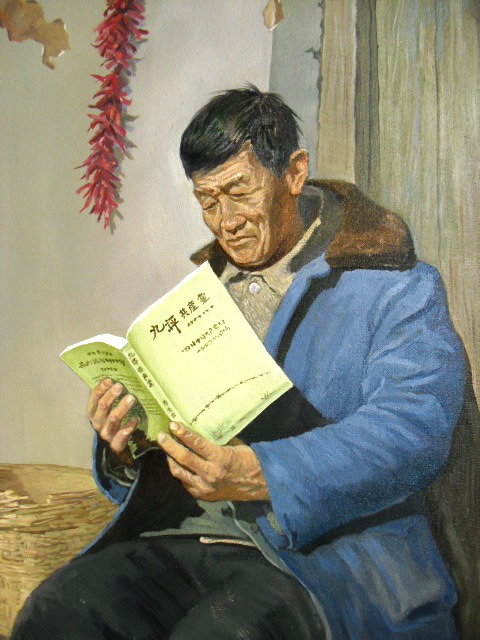
The wave of red terror, which shattered families and demolished ancient buildings, was orchestrated by the Chinese Communist Party (CCP) and spread throughout China from 1966 to 1976 under the rule of Mao Zedong. The number of unnatural deaths during this bloody calamity was conservatively estimated at 7.73 million, according to the award-winning ‘Nine Commentaries on the Communist Party’
(http://www.ninecommentaries.com/).
Instead of solely photographing the ‘glorious’ moments of the Cultural Revolution, which could appear in newspapers, Mr Li audaciously snapped images that framed a sombre account of this bloody 10-year revolution and stashed the negatives in secrecy underneath his desk. He thought: “Someday, people might want to see the light.”
These grim images of violent scenes, which allude to the dark side of the Cultural Revolution, were deliberately obscured from the public during the revolution.
Mr Li became the premier documenter of the Cultural Revolution, and his historic photographs have been exhibited worldwide. In Singapore, his exhibition run from Sept 10 till Oct 29 at The Arts House at The Old Parliament.
“My teacher told me that a photographer should not only witness history, but also record the true history,” he said.
In Witness: The Archive of Cultural Revolution’, a public talk held at The Arts House on Sept 11, Mr Li shared his insights on this tumultuous period in Chinese history.

THE HIDDEN PHOTOS


These grim images of violent scenes, which allude to the dark side of the Cultural Revolution, were deliberately obscured from the public during the revolution.

SWIMMERS PREPARE TO PLUNGE INTO THE SONGHUA RIVER

WATCH: Part 1 – Li Zhensheng’s Public Talk (Witness: The Archive of Cultural Revolution) 
Swimmers prepare to plunge into the Songhua River to commemorate the second anniversary of Mao’s swim in the Yangtze River, on July 16, 1968. (Courtesy of Li Zhensheng, Singapore International Photography Festival 2016)
The above photo captured a team of swimmers reading Mao’s little red book before diving into the water. At that time, according to Mr Li, Mao was believed to “help and direct your swimming, so that you won’t get lost in the water”.
The audience laughed upon hearing this.
“Back then, you would probably be in trouble if you laughed about this,” said Mr Li with a serious expression on his face.
‘Nine Commentaries on the Communist Party’ explains that “the Chinese people have not only been deprived of freedom of thought, (but) they have also been indoctrinated with the teachings and culture of the Party”.

THE DESTRUCTION OF TEMPLE OF BLISS

WATCH: Part 2 – Li Zhensheng’s Public Talk (Witness: The Archive of Cultural Revolution) 
A scene of the Red Guards ransacking Jile Temple (Temple of Bliss) in 1966 (Courtesy of Li Zhensheng, Singapore International Photography Festival 2016)
The CCP’s Red Guards ordered three monks from Temple of Bliss to hold a poster board with these words: “What sutras? They are full of shit.” (Original photo from 5th SIPF 2016 – Witness: The Archive of Cultural Revolution
When the Cultural Revolution first began, Mr Li was very hopeful and enthusiastic as he believed it could help advance the development of culture. However, the event turned out to be beyond his imagination. An inordinate outburst of violence and struggle sessions occurred soon after the onset of this socio-political upheaval. What struck him, in particular, was the assault on the party leader of Heilongjiang, Ren Zhongyi, who was “an amicable man”.
According to the ‘Nine Commentaries’, “struggle” was the primary “belief” of the Communist Party to create terror and maintain its rule in China. Through terror, the “Chinese people tremble in their hearts, submit to the terror, and gradually become enslaved under the CCP’s control”.
Mr Li was also shaken by the destruction of temples.
The photo above shows the destruction of the famous Temple of Bliss located in Harbin city, Heilongjiang Province. The temple, which housed many cultural relics and was the biggest Buddhist temple built in modern times (1921), was wrecked during the Cultural Revolution.
“The Communist Party does not believe in God, nor does it even respect physical nature,” the ‘Nine Commentaries’ points out. The Cultural Revolution motto (“Battle with heaven, fight with the earth, struggle with humans—therein lies endless joy”) had caused the Chinese people to suffer enormous suffering and agony.
“How could they ruin this culture in the name of Cultural Revolution?” Mr Li thought.
After witnessing this appalling spate of attacks and destruction, Mr Li started having ambivalent feelings towards the Cultural Revolution.

PUBLIC SHAMING BY THE CCP’S RED GUARDS 

WATCH: Part 3 – Li Zhensheng’s Public Talk (Witness: The Archive of Cultural Revolution) 
Public shaming by the Red Guards in front of masses, 1966 (Courtesy of Li Zhensheng, Singapore International Photography Festival 2016)
Public shaming by the Red Guards in front of masses. (Original photo from 5th SIPF 2016 – Witness: The Archive of Cultural Revolution)
Public shaming by the Red Guards in front of masses. The victim was forced to wear a tall dunce hat with accusations written on it. (Original photo from 5th SIPF 2016 – Witness: The Archive of Cultural Revolution)
“Guess what was the placard made of?” Mr Li pointed to a photo on the screen and asked the audience.
The photo portrayed the humiliation of victims being criminalised during the Cultural Revolution. The victims were forced to hang placards around their necks, which accused them of being counter-revolutionaries.
“Cardboard? Wood?” the audience guessed.
“These are all answers from logical minds. In reality, the placard was actually made of metal attached with a metal string, which was tied to one’s neck. The accused had to struggle to hold the placard as it was heavy,” said Mr Li.
His words took the audience completely by surprise.
Next, Mr Li called attention to a photo showing a victim wearing a tall dunce hat with accusations written on it. When he was at the scene, he was baffled to see the accused standing straight, in a posture of subservience. To his amazement, he was told that bricks were hidden inside the dunce hat.
“They had to stand straight to support the bricks,” he said emphatically.

HIS FIRST LOVE

Mr Li reminisced about his first love during the two-hour talk. The couple was acquainted with each other during their university days, but they broke up due to the revolution.
His girlfriend’s mother, a textile worker in Dalian, was accused of being a wife of a landlord. Tragically, this dignified, middle-aged woman became one of the first persons he knew to commit suicide during the Cultural Revolution.
“Her mother hung herself and lost consciousness. When she regained consciousness, she realised she had a watch. She left her watch to her daughter, and hit her head against the wall,” he said ruefully.
Overnight, his girlfriend was labelled one of the five ‘black elements’ – “landlord’s daughter”, which was a stigma at that time. His heart sank when his girlfriend approached him and suggested they broke up. She ascribed her ‘bad element’ as a hindrance to his career.

THE MOMENT OF TRUTH

WATCH: Part 4 – Li Zhensheng’s Public Talk (Witness: The Archive of Cultural Revolution) 
In a twist of fate, he married Zu Yingxia, who was his colleague at Heilongjiang Daily.
Merely 10 months into their marriage, his wife was staggered when she received horrifying news about her father ending his own life. Her father, who was a low-level physician in a small township, was wrongfully accused of being a Japanese spy, for no reason other than the fact that he had cured a Japanese railway worker during the Japanese colonial period.
“They tried to make him confess. He succumbed to the inhumane torture and committed suicide,” Mr Li bewailed.
His wife cried her heart out throughout the night. The next day, she confessed to her work unit that her father had died of shame and she wanted to terminate her relationship with her father.
“My wife turned herself in and felt ashamed that she had betrayed the party and the people. That was the standard formula at that time if you had a family member who committed suicide,” explained Mr Li.
The ‘Nine Commentaries’ states that during the Cultural Revolution, “[if] a person committed suicide, he would be labelled as ‘dreading the people’s punishment for his crime’” and “his family members would also be implicated and punished”. Hence, “it was all too common that fathers and sons tortured each other, husbands and wives struggled with each other, mothers and daughters reported on each other, and students and teachers treated each other as enemies”.
The suicides – coming so quickly on the heels of one another – rattled Mr Li and made him waver in his support for the revolution. By that point, Mr Li was completely aghast at the cruelty of the Cultural Revolution. And that was the moment of truth for him.
In Mr Li’s opinion, those who committed suicide during the Cultural Revolution were “very courageous, because they were trying to defend their dignity”.

HIS CHINA DREAM


“I love China. I am using this method to show my love for my homeland. We should reflect on the true history, so as to prevent such tragedies from ever recurring.” – Li Zhensheng, a former Photojournalist

The Cultural Revolution was a dark period in China’s history, replete with paranoia, bloodshed, killings, grievance, loss of conscience, and confusion of right and wrong. Mr Li’s China dream would be that one day, he could hold his photo exhibition in China and share with the young people in China “the true history of the Cultural Revolution”.
“I love China. I am using this method to show my love for my homeland. We should reflect on the true history, so as to prevent such tragedies from ever recurring.”

EDITOR’S NOTE:

Some people may think that these brutalities belong to the past, and that CCP has changed. However, the savage persecution of Falun Gong – a traditional Chinese meditation practice that adheres to the principles of “Truthfulness, Compassion, and Tolerance” – in recent years indicates otherwise.
The persecution of Falun Gong signals another oppression as vicious as the Cultural Revolution. CCP continues to use the same old methods of inciting hate and instigating violence against Falun Gong by “ruining their reputations, bankrupting [them] financially, and destroying [them] physically”.
Under the deceptive façade of the Chinese Communist Party, a state-run medical genocide has been carried out by the Chinese Communist Party since 2000, which may have performed up to 1.5 million organ transplants from unwilling live donors, mostly from Falun Gong prisoners of conscience, according to a new China organ harvesting report published on June 22. [1]
————————————————————————–
[1] Robertson, Matthew. “Report Reveals Vast State-Run Industry to Harvest Organs in China.” Epoch Times. 22 June 2016. http://goo.gl/Bd8MR3